
Great Poems from Substack Poets
Krug's Poetry Tournament Winners

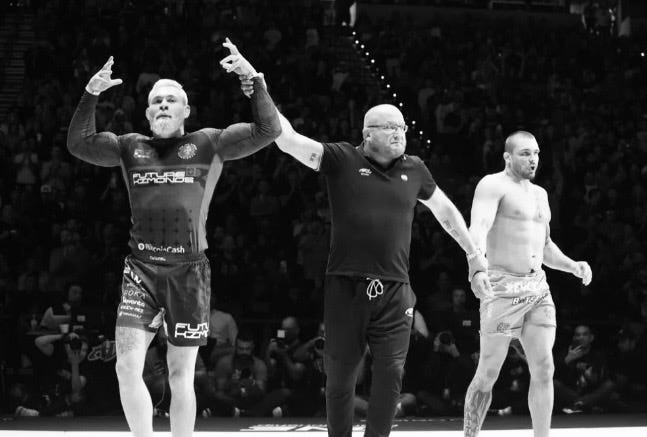
The Tournament
A little over a month ago I called for submissions for my very own poetry tournament. My goal was to find some of the best emerging poets here on Substack, to provide a place where they could submit, and to champion them. As I stated in the original article:
The model I had in mind was the weekend BJJ tournament. The goal of these meets is not to crown world champions but to give practitioners the chance to pressure test their skills and experience the pains of competition. It builds community and makes everyone better.
I had around 30 entries in total, and I have been reading them carefully for a few weeks now.
I have listed the winning poems below, and I would suggest that you all follow these people if you like poetry. Many of them are creating great work.
The Brackets
I settled on three ranks (beginner, intermediate and expert) and two divisions (formal and free, kind of like gi and nogi).1 So each bracket had around 5 people in it. That may not seem a like a lot, but I received very good quality submissions (even from the beginner divisions) and the competition was fierce.
Each rank also has a brilliancy prize, which was given out based on the strength of a particular line, image or idea. I have included a brief explanation of why I chose those specific lines, and the full poems are in the footnotes.
Finally, I included the absolute division, which crowns my personal favourite poem, and a wild card, which went to the craziest poem.
Judging Criteria
I didn’t have any particular criteria in mind and did my best to judge each poem on its own merits. That meant taking into account what the poet was trying to do, discerning what values the particular poem had, and feeling how memorable or powerful the experience was.2 As you will see below, the winners are very diverse. They are writing about different things, in different styles, and achieve their effects in different ways.
This made judging a bit difficult because I couldn’t default to any underlying criteria: there was no way to say why one entry was a better fit for the theme or for the aesthetic of my blog. Sometimes this wasn’t an issue because there was a clear winner, but in a few cases (especially in the advanced divisions) I had to default to my own taste to break certain ties.3
Winners:
Beginner Formal: jonathan — Remember Me
Beginner Free: Akira — Ursa Minor
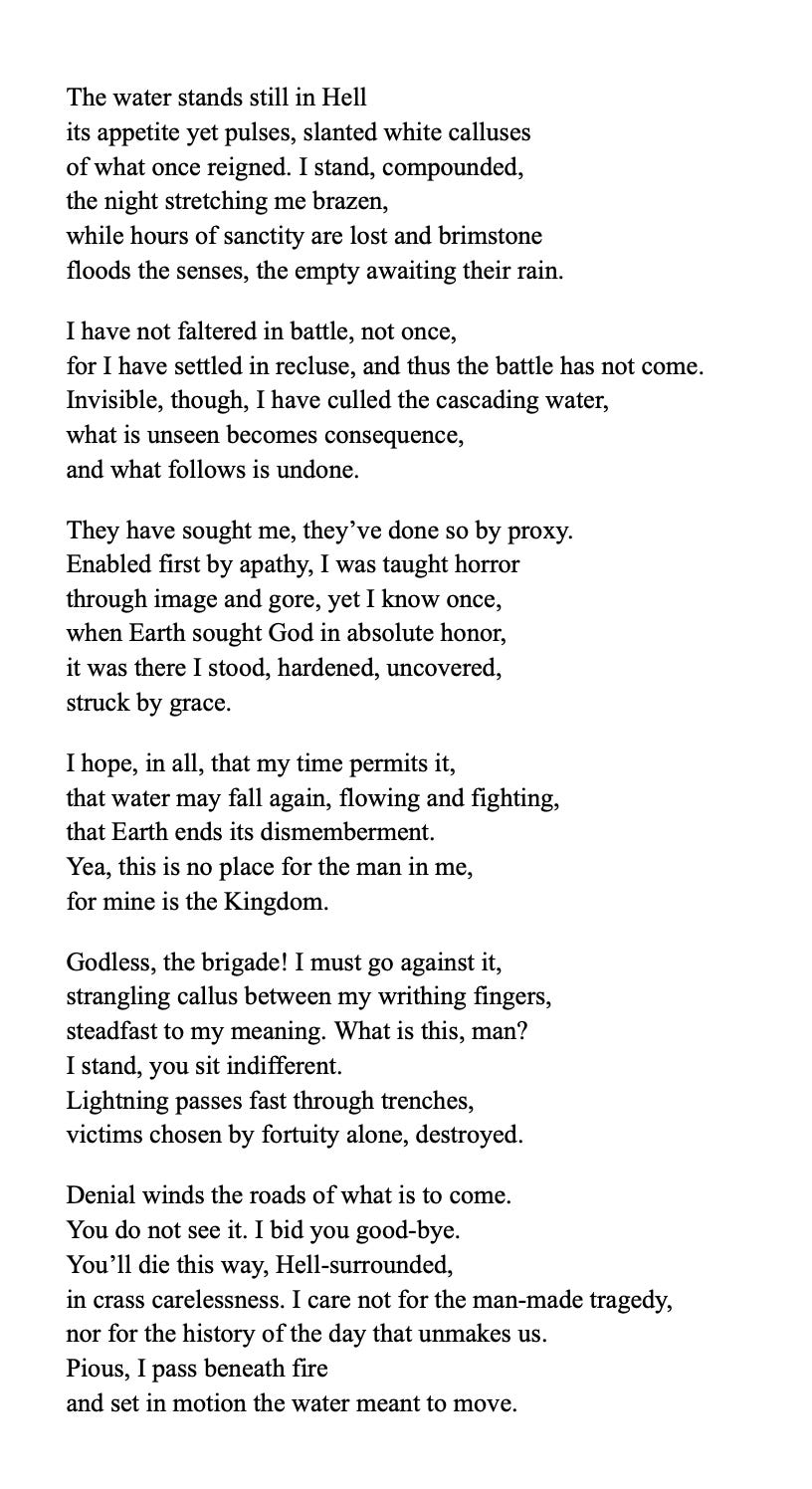
Beginner Brilliancy: cinnamon cyclone — The water stands still in hell
Intermediate Formal: Thomistic Mishima — “If you will not sing…”
Intermediate Free: Bence Ádók — Fumalsamakah
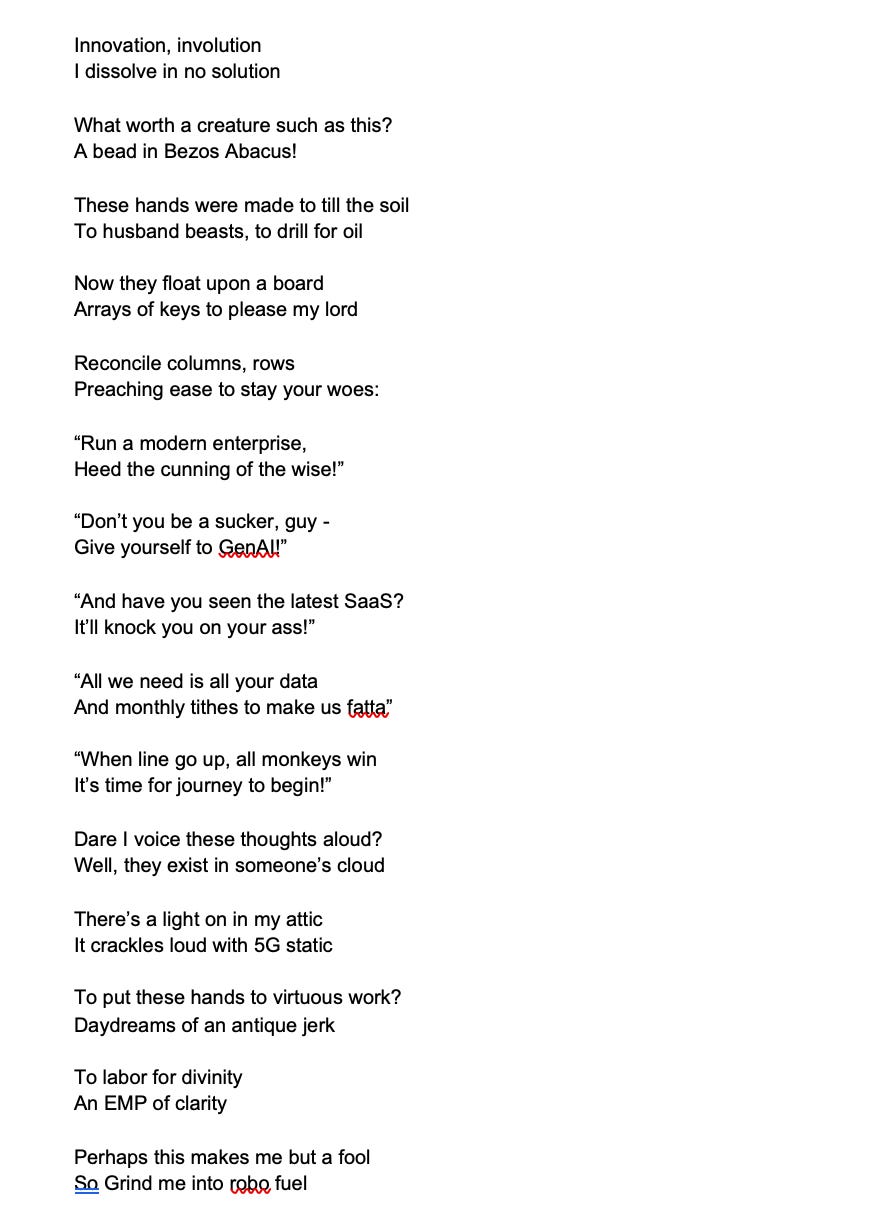
Intermediate Brilliancy: Centaur Write Satyr, PhD — Silicone Hourglass
Advanced Formal: Alex McKeown — Villanelle
Advanced Free: Tom Beck — Poise
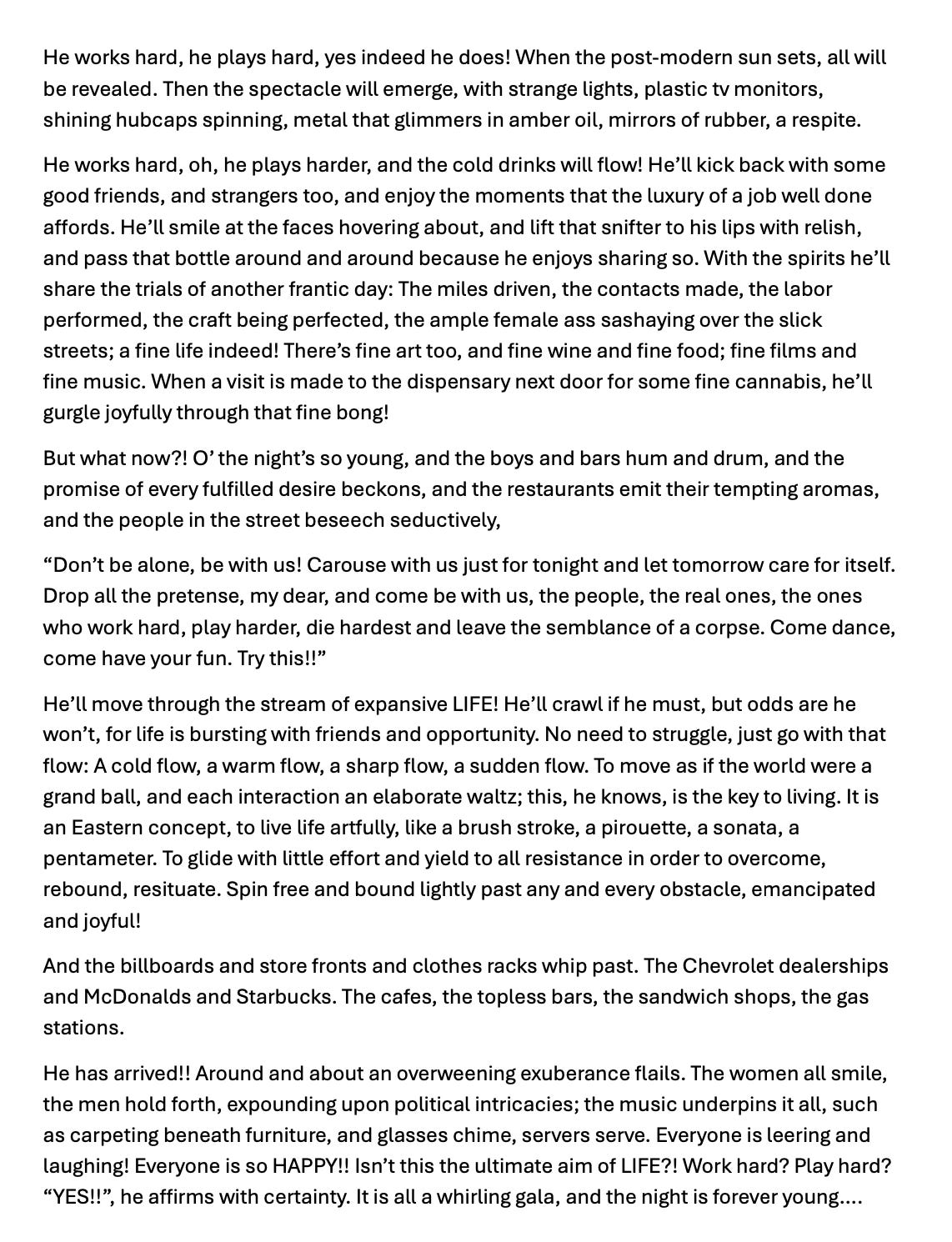
Advanced Brilliancy: Rohit K — The Flaneur
Absolute Champion: ???
Wild Card: @twotienegroni — In Memory of Charles Bukowski
Beginner’s Bracket
Formal Verse Winner: jonathan — Remember Me
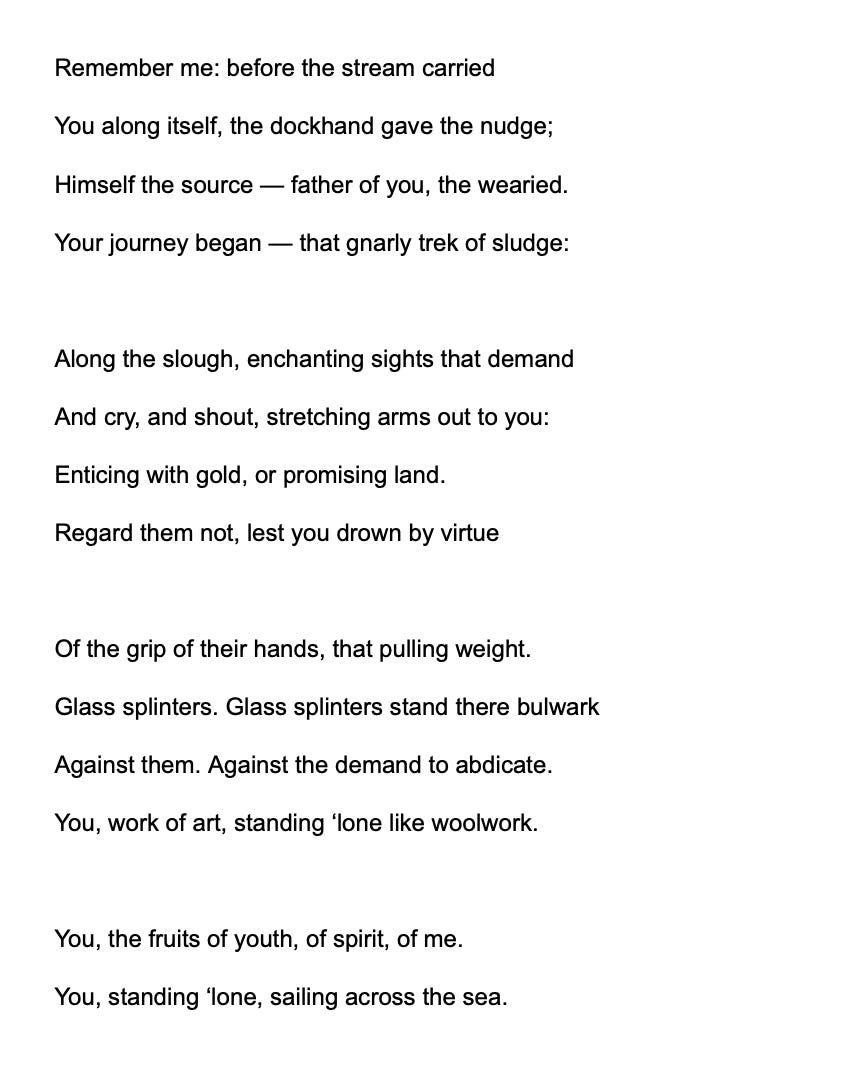
Johnathan was one of the youngest people to submit and has been writing poetry for less than a year. He submitted this very traditional sonnet.
This poem is about the relation between the past and future self. The speaker is admonishing his future self to remember the past, specifically, the past self who set it all in motion. From the conceptual standpoint I find it interesting because of the tension between addressing the future and acting in the present. The speaker is writing to his future self, whom he refers to as a “work of art” and “the fruit of youth, of spirit, of me”—but the speaker is not any of those things… yet. This makes it a poem about hope, ambition and faith as well: the speaker trusts himself to become this superior person.
Ostensibly, the poem is about memory and having veneration for the past; and if Johnathan were 50 years old, then this would be the main theme. But because he is young, because the future is not yet set, the dominant note is one of determination and inner confidence. The trials he describes are not things that have been overcome but things that must be overcome. The tone is not retrospective but optimistic; it is the spirit of youth.
Writing a sonnet is no small feat. There are a few lines here that are a bit awkward, but there is also much to admire. Stanza three in particular has some interesting repetitions; and the rhyme of “weight” with “abdicate” is quite nice—especially because the “abdicate” has regal associations. Failure, then, is not just the inability to become yourself (whatever that means) but also a kind of renunciation of one’s birthright. The future self is a king, a temporal king and his kingdom is the beauty of the past.
Free Verse Winner: Akira — Ursa Minor
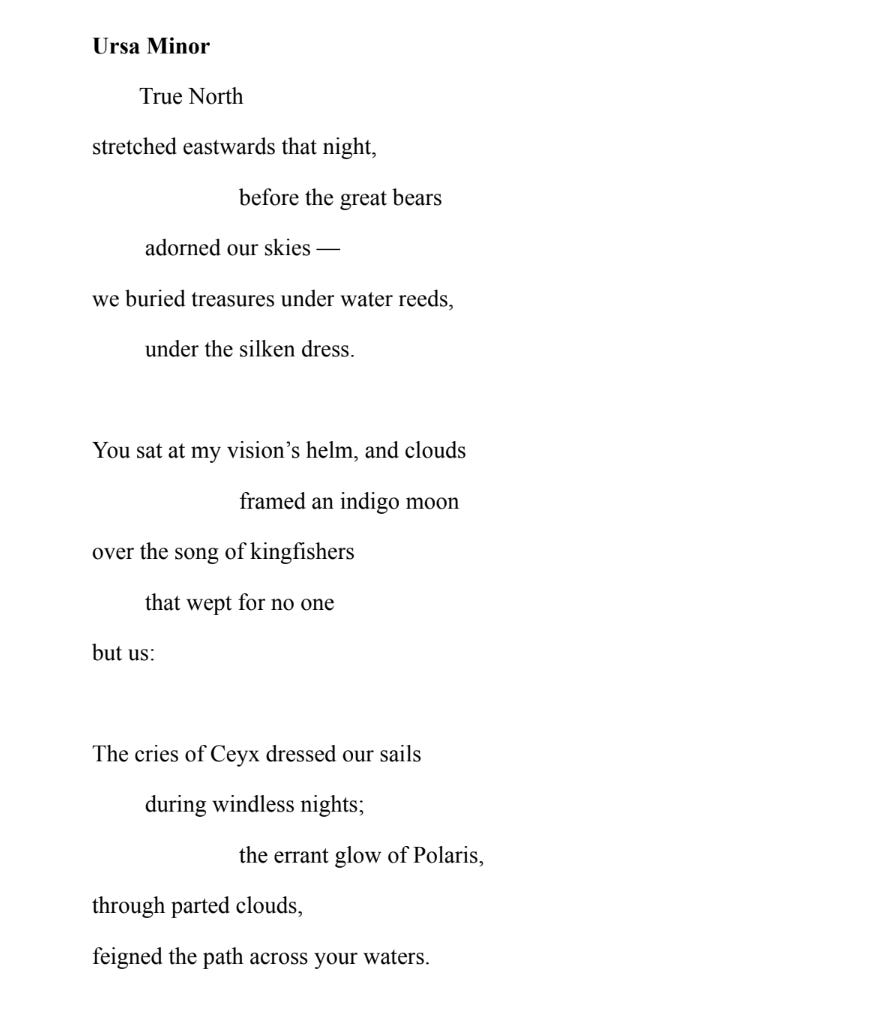
Akira describes himself as “a Brazilian-Japanese poet whose work explores intimacy, home, and myth through the language of celestial and natural imagery.” He has only been writing for a short time as well, but this poem was among my favourites regardless of category.
The content of the poem is rather simple, if dense with allusions and images, but what impressed me was Akira’s formal control and linguistic inventiveness. This poem also has something that usually takes poets a very long time to develop: atmosphere. The last stanza in particular just strikes me in a primitive way that is difficult to describe. I do not just understand what the poem is about: I feel the the way the water looks when cloud-filtered starlight rests upon it. This is very high praise, and I have reread the last few lines many times simply because of how beautiful they are.
The phrasing itself also deserves to be mentioned. The “errant glow” is very nice, and the final line is gorgeous. I hope Akira keeps working in this vein because this is the kind of stuff I love to read.
Brilliancy: cinnamon cyclone
Cinnamon’s poem,4 The water stands still in hell, wins the brilliancy for it’s final two lines. I don’t even need to look them up because they engraved themselves in my memory as soon as I read them, which is about as good a compliment as I can give:
Piously, I pass beneath fire
and set in motion the water meant to move.
This was a strong entry in general, but these two lines have a magic for me that I can’t quite explain and, like all good poetry, need no explanation.
Intermediate Bracket
Formal: Thomistic Mishima — “If you will not sing…”
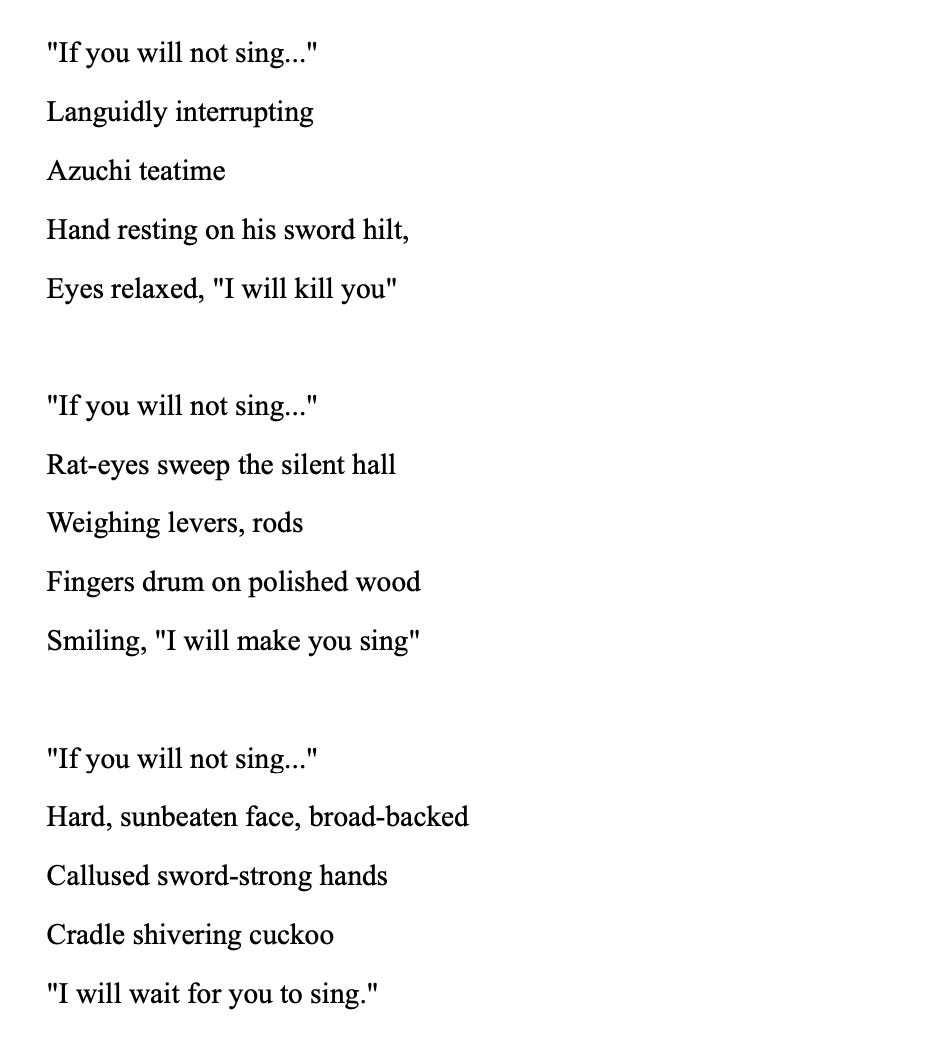
Thomistic Mishima lives in Texas and is an aspiring fire fighter. He is also a man of refined sensibilities who knows his history. His poem is a traditional Japanese tanka about the “three great nobles,” the founders of modern Japan: Saigō Takamori (the warrior), Ōkubo Toshimichi (the schemer) and Kido Takayoshi (the ascetic). The poem is an elaboration on a classic joke about these three and their respective approaches to life.
Along with the technical demands of the form, which require a syllabic patterning of 57577, there is a very elegant pattern here. Each stanza is formed around an if/then conditional, which acts as a kind of shell around which a brief sketch of the person is drawn. These are well executed, and certain lines are beautiful in and of themselves (“rat-eyes sweep the silent hall”). It’s a good example of the kind of effects that are unique to poetry.
What I admired most about this poem, however, was the way it moved within this rigid structure. Each stanza not only stands on its own but all three feel unified. They aren’t three distinct portraits but a single moving picture whose unfolding proceeds with a certain inevitability: from brutality to cunning to mind—almost like the three parts of the soul.
Free: Bence Ádók — Fumalsamakah
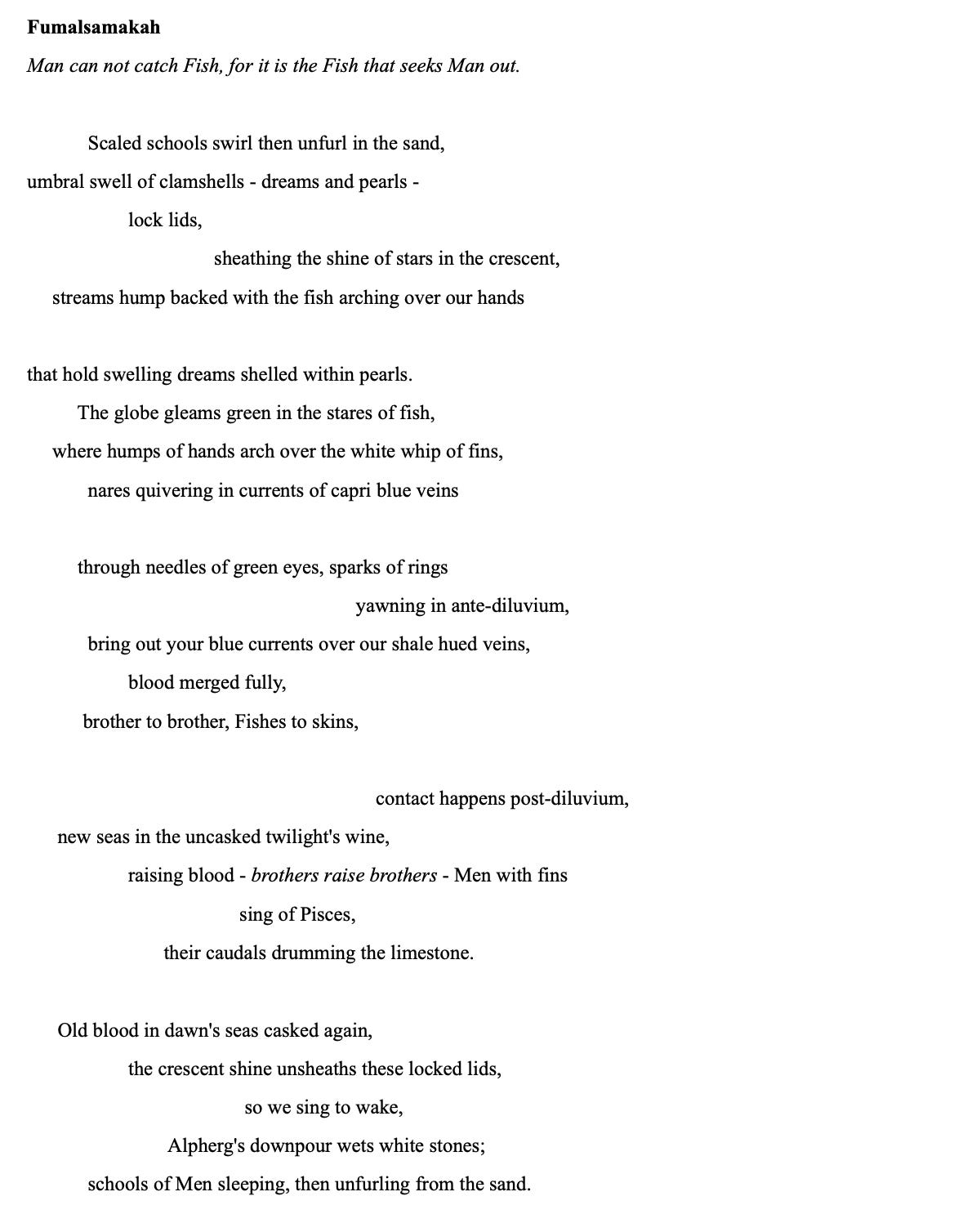
Bence is “a man with no fortune and a name to come.” He is also the writer of the most verbally adventurous submission. Bence claims that this is an experimental take on the pantoum form, but the the main thing I noticed is the texture of the language.
To be perfectly honest with you all, I don’t know what’s going on in this poem, which is not necessarily a bad thing.5 The poem’s title, Fumalsamakah, is the name of a star in the constellation of Pisces, the final sign in the zodiac. Dissolution is a recurring theme, evoked by images of the sea, twilight and various forms of communion. These images and symbols, layered according to the loose pantoum structure, create an atmosphere that I really enjoyed.
But what I liked most about this poem was Bence’s willingness to push the language. I enjoy poets like Dylan Thomas, Hart Crane, Gerard Manley Hopkins, Amy Clampitt and other writers with a dense, sugary style. Bence is definitely in this camp, and there are many adventurous lines here. Some were a bit too strong for me, but many, like “bring out your blue currents over our shale hued veins,” were very nice.
The final thing I’ll mention is the line “Old blood in dawn’s seas casked again,” which refers to three different liquids: blood, water and wine. Here it seems as though the language itself is breaking down, returning to piscean formlessness. It is a great example of linguistic compression.
Brilliancy: Centaur Write Satyr, PhD
Centaur’s poem,6 Silicone Hourglass, was in the formal category. He wrote in a lightly comic poem in heroic couplets about technology, and it included these two lines:
To labor for divinity
an EMP of clarity
The entire poem is about man’s place in the technological world, and I loved the metaphor the EMP metaphor. It fits within the context of the poem, but the idea of obliterating the world’s static, of symbolizing a violent, apophatic revelation with an EMP impressed me.
Advanced Bracket
Formal: Alex McKeown — Villanelle
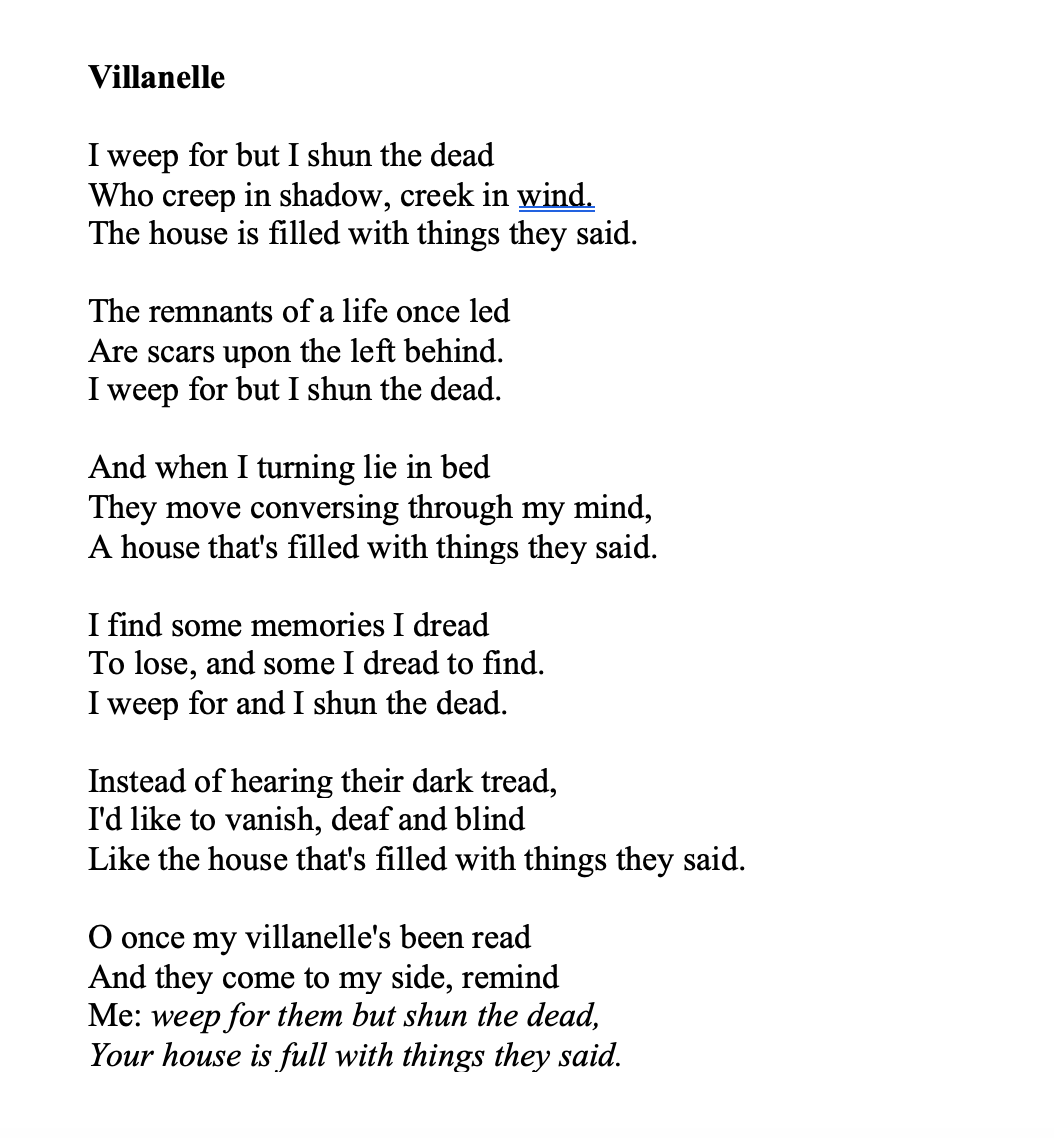
Alex McKeown is the author of We Leave Gaps (Walleah Press, 2025) and translator of Love in the Fields (Penteract Press, 2022). His poems and translations have appeared widely in Australia and overseas in outlets such as Southerly, Island and Cordite.
Alex does not know this (we’ve never corresponded), but I am a huge villanelle fan. It’s a very difficult form to pull off, but Alex makes it look easy. Everything here is done masterfully: the slight variations of the refrains, the non-intrusive rhymes, the steady iambic beat—all of it seems so simple and obvious. Although I like the poem as a reader, the poet in me takes great pleasure in contemplating these subtleties.
To give you an idea of what I’m talking about consider the first refrain: “I weep for but I shun the dead.” This is already a strong line, and it’s elegantly placed throughout the poem. At the end, however, McKeown does something very cool. He wants to use the word “remind,” which is a nice rhyme that fits with the themes of memory and the past; but this requires that he start the final refrain with “Me” instead of a “I”—and this should screw everything up. Instead of taking it’s usual, active form (“I weep…”) the line becomes a command: “weep for them but shun the dead”. This is such a small change you don’t even notice it. It’s seamless and therein lies its brilliance.
This seamlessness is due to the way McKeown manipulates the rhythm. In every other instance of this refrain the word “but” (or “and”) is stressed: “I weep for but I shun the dead.” But the final refrain reverses this: “Me: weep for them but shun the dead.” This ingenious variation is so smooth that the ear hardly even picks it up. It seems like such a small thing, but this subtle change also radically transfigures the meaning of the poem because it distinguishes between those for whom the speaker weeps and the dead. Nuances like this are what allow us to reread poems over and over again.
Perhaps some of you will think that I’m too focused on minutiae, but as someone who has tried writing multiple villanelles, I know these kinds of problems can easy ruin a poem. It either takes an act of genius or many hours of work to resolve a problem like this so gracefully. We would all be much better off if poets stopped trying to make memoirs and manifestos out of poetry and instead focused on putting their words in the perfect order like McKeown does here.
Free: Tom Beck — Poise
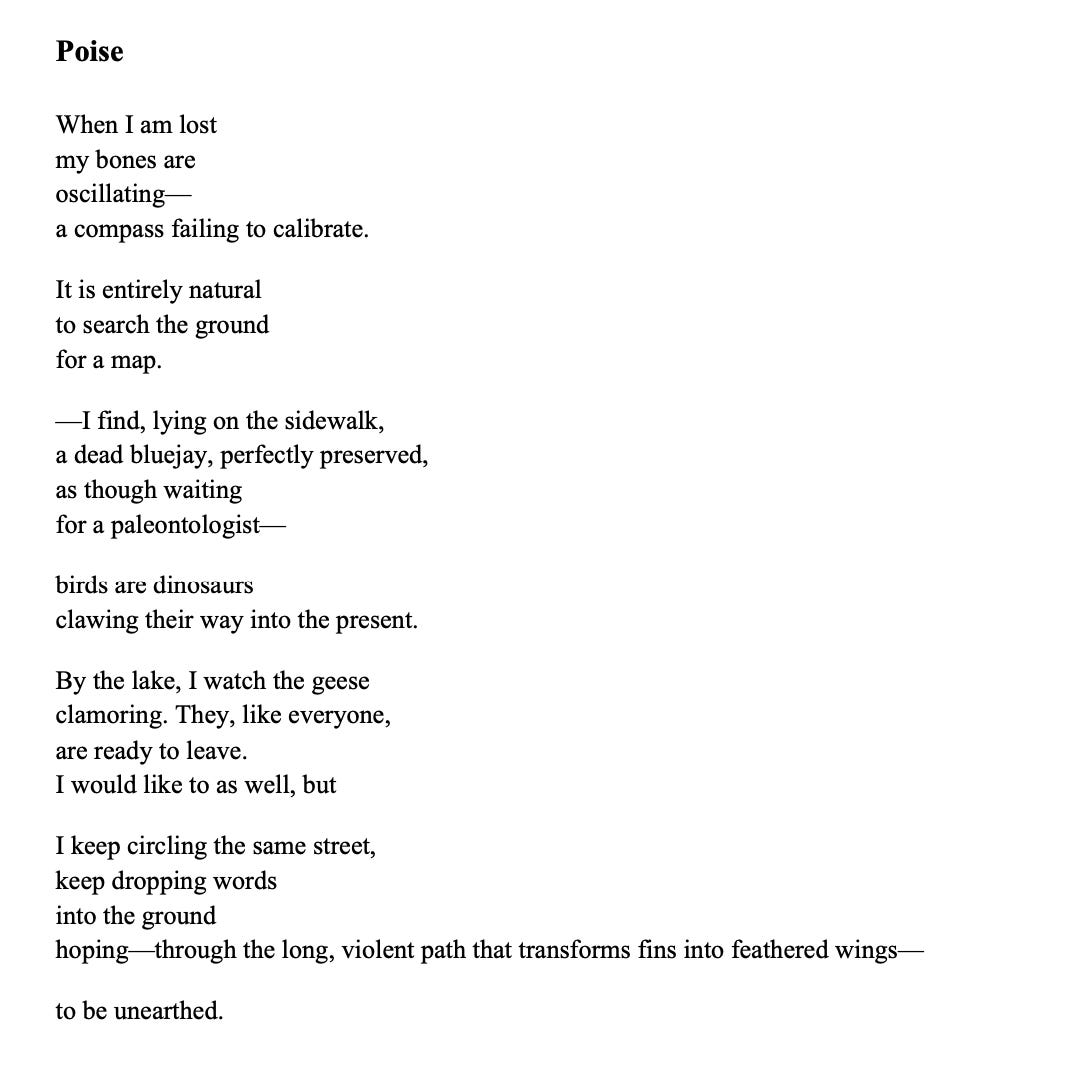
Tom Beck lives in Minnesota. He is the author of the poetry chapbook The Shape of Absence and writes fiction and essays on his Substack, The Driftless. One of the big things I look for in poetry is unity, but how one goes about achieving that differs from person to person. Beck’s poem is certainly unified, though not by any formal conceits. His harmony comes about by consolidating many different elements, compressing different images, sounds and associations into the last line, where everything suddenly comes alive. That’s how I read it at least.
It’s very difficult to write about these mysterious poetic amalgamations, but I’ll do my best. In Beck’s poem we find birds, bones and bemusement. A few chosen essences repeat again and again, and there is something explicitly cyclical about this poem as well—the uncalibrated compass, the obsessive circling of a street, the words being dropped. Beck clearly sees something, but he maintains a safe poetic distance, never attempting to articulating exactly what it is that he feels. He spends the whole poem moving back and forth from one vibe to another, and these oscillations evoke not just a meaning but something much more poetically important: an atmosphere. I don’t quite know what to call this vibe, but I feel it.
There are quite a few great lines here, but the final one is what stands out to me: that’s where everything magically congeals. And there is some cool technical stuff going on here, too. The final line—and the only one line stanza in the poem—is a passive infinitive. Now, why is this so interesting? The infinitive is, as you would expect, a non-finite form, meaning it is not bound by any person or tense. It is the language of the primordial and the essential.7 That final line is where all the dead birds, dinosaur bones and literary aspirations fuse into a single feeling. It’s a very skillful use of space and a good example for poets hoping to write in free verse. The sentence of which the final line is a part is based around the finite verb “keep,” but Beck’s use of space makes the infinitive the dominant element.
I’m writing about this like a pedant, but the effect for the reader is immediate. Persoanlly, I didn’t feel that the speaker was saying “I keep… hoping… to be unearthed.” I felt the whole poem unified around the eternal: to be unearthed.
Brilliancy: Rohit K — The Flaneur
Our final brilliancy8 prize goes to Rohit, who submitted a prose poem. Rohit is a retired farmer living in Portland, Oregon with his wife and two young daughters. He presently works in a warehouse, and his piece, The Flaneur, depicts the emptiness of the man who works hard and plays hard.
I liked this poem in general, and there is a great deal of poetry in Rohit’s prose. But the final stanza/paragraph really stood out for me:
He has arrived!! Around and about an overweening exuberance flails. The women all smile, the men hold forth, expounding upon political intricacies; the music underpins it all, such as carpeting beneath furniture, and glasses chime, servers serve. Everyone is leering and laughing! Everyone is so HAPPY!! Isn’t this the ultimate aim of LIFE?! Work hard? Play hard? “YES!!”, he affirms with certainty. It is all a whirling gala, and the night is forever young.
Rohit does something remarkable here, something I’ve never seen before: this is the only piece of writing that uses ALL CAPS in a way that doesn’t annoy me. Normally I would find this irritating—and when I first glanced at the page, I was irritated. But Rohit’s emphasis of “HAPPY” and “LIFE and “YES!!” (note the double exclamation mark) works incredibly well and evokes something exceptionally subtle. It gives the impression of a false smile, of the desperate, contorted grin that lies upon the faces of people who are merely going through the motions in a doomed attempt to affirm the inherent emptiness of their lives. I have thought a lot about this, and I don’t think it wouldn’t work with italics or bold type. The particular mood that is expressed requires that these words be in all caps, in my opinion, and Rohit’s poem has made me rethink some ideas I have about punctuation and our current sensibilities.
Absolute Champion: Akira
Seems strange to give the top prize to the poem of a beginner, but the champion is merely the poem that I enjoyed the most. At the end of the day I have my own predilections, and I read this stuff solely because it gives me pleasure—mental pleasure. The diversity of winners attests to the fact that there is more than one way to write a poem, but I’m a sucker for stars, water and light on the water. The final three lines of Akira’s poem are what did it for me: “The errant glow of Polaris, / through parted clouds, / feigned the path across your waters.”
These lines don’t need some lengthy analysis; their beauty just struck me in a primitive way, as all good poetry does. Not everything needs to be so complicated. In fact, people would read far more poetry if they stopped worrying about unlocking occult secrets and focused only on what they felt as beautiful, interesting or profound, because at the end of the day these are the things that are truly occulted. Henry Miller is eloquent on this point:
The modern poet seems to turn his back on his audience, as if he held it in contempt. In self-defense he will sometimes liken himself to the mathematician or the physicist who has now come to employ a sign language wholly beyond the comprehension of most educated people, an esoteric language understandable only to the members of his own cult. He seems to forget that he has a totally different function than these men who deal with the physical or the abstract world. His medium is the spirit and his relation to the world of men and women is a vital one. His language is not for the laboratory but for the recesses of the heart. (Miller, Henry. The Time of the Assassins: A Study of Rimbaud.)
Wildcard: TWO TIE NEGRONI — In Memory of Charles Bukowski
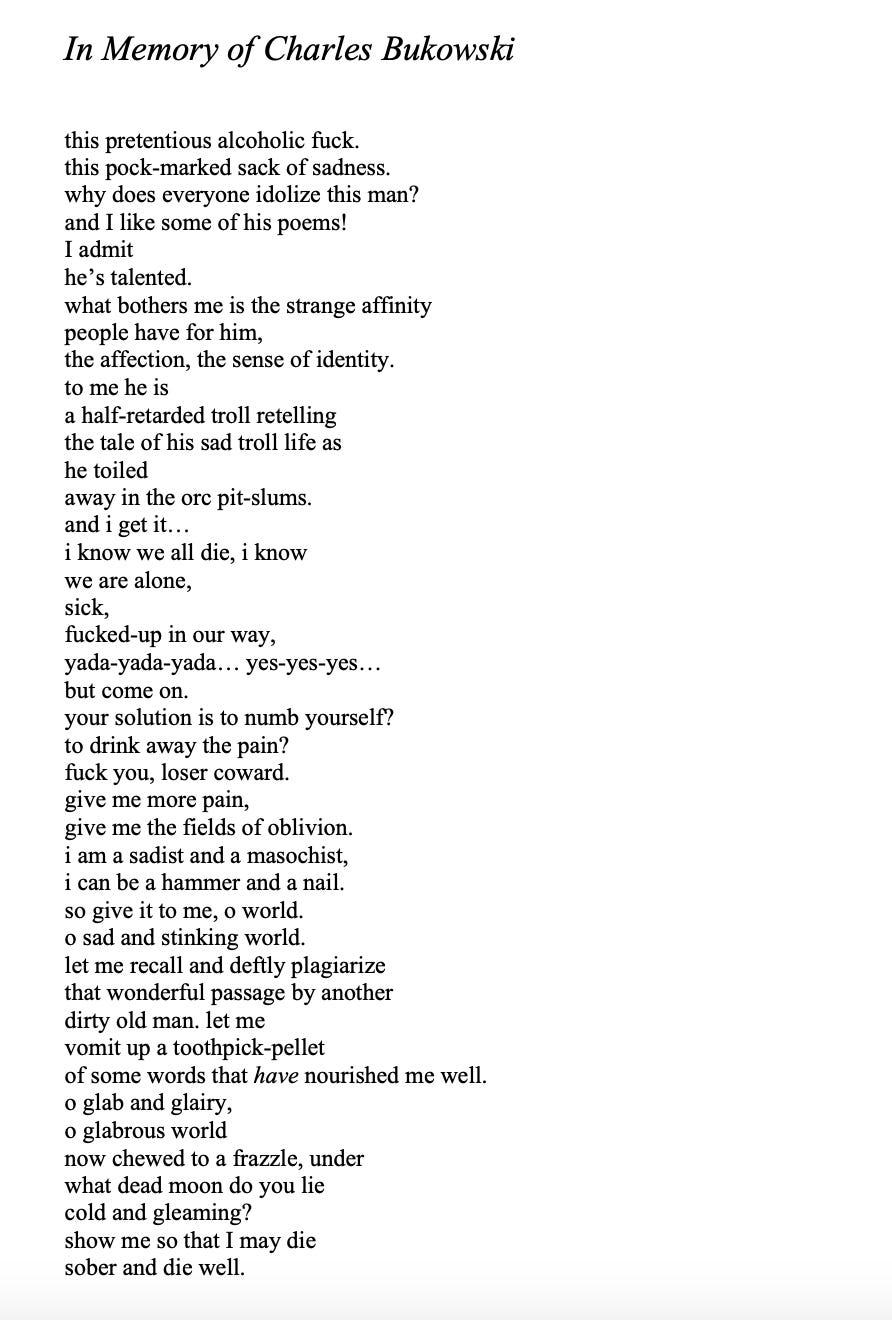
This entry from the advanced free division is the most unhinged poem I received, which is saying something because I got some great stuff from people like Aaron Barry/Jasper Ceylon, Centaur Write Satyr, PhD, ringleader and others. I didn’t feel that this one deserved to win, but it is worth highlighting—if only because it made me laugh.
Upon reading the title one might assume that some form of veneration is to follow. I half expected an homage or elegy along the lines of Auden’s In Memory of W.B. Yeats or Tennysons’s In Memorium of A.H.H.. But that’s not what we find. From the first line Bukowski is derided as a “pretentious alcoholic fuck,” and the poem does not let up.
Instead of an homage or an elegy we get a torrent of abuse. Bukowski is not glorified but mercilessly attacked. Some of these are a little unfair (I actually like some of Bukowski’s stuff), but the verbal energy in some of these lines is remarkable. There’s a kind of manic defiance running through this poem that I find very interesting, and I hope TwoTieNegroni continues writing this stuff. It’s certainly interesting.
Thank you again
I appreciate all the submissions that I received. I had a lot of fun doing this, and I hope to do it again at some point. Perhaps in the future I will give a little more time and select a theme.
If you guys have any feedback about how you’d like to see future tournaments play out, please let me know in the comments or shoot me a DM. I would like to do this again at some point, and I will try to improve as we move forward.
A few people submitted experimental or prose poems, but I placed those in the the free verse brackets because I didn’t have enough of them.
I will probably do an article about what I look for in poetry at some point in the future, but I trust my intuition in these things. I can’t always explain why I like a line or a particular poem, but I trust my heart more than my mind in these matters.
I suppose this is where personal taste can intrude. How am I to choose between a great villanelle about loss and a great sonnet haiku about a river? What standard can I use? In my case, I just happen to love villanelle’s. That might not be fair, but in cases such as this when there is no clear winner, I don’t think the categories of fair and unfair can be meaningfully applied. This is a problem I must thin more about, however.
The water stands still in Hell
There are plenty of poems I enjoy that I do not understand, and I’m not alone here. Tennessee Williams said the same about Hart Crane; as did James Merrill about Mallarmé.
Silicone Hourglass
I have a personal interest in this because I think that infinitives are how we talk about essences, but that doesn’t affect the reading of this poem.
The Flaneur
Genuinely honored to see my poem at the top of its bracket. Thank you so much, Krug! I loved the concept of this competition and enjoyed reading all the interesting and beautiful poems that you selected. I hadn't written much poetry for years, but this made me want to jump back into it.
It was also gratifying to read your commentary, especially your focus on the final line. I revised this poem many, many times, and the final line changed in virtually every revision. The passive infinitive was the big unlock because I realized I could finally fuse everything that wanted to be together: the bird, the dinosaurs, the speaker. Very cool to see that effect land in your reading!
Thanks Krug, glad to have won a bracket. The varied selection of poems and your write-ups about them are both great to read!