
The Two Literary Realms
The MFA Novel Is Dead. Here's the Deeper Vocation Writers Have Forgotten.

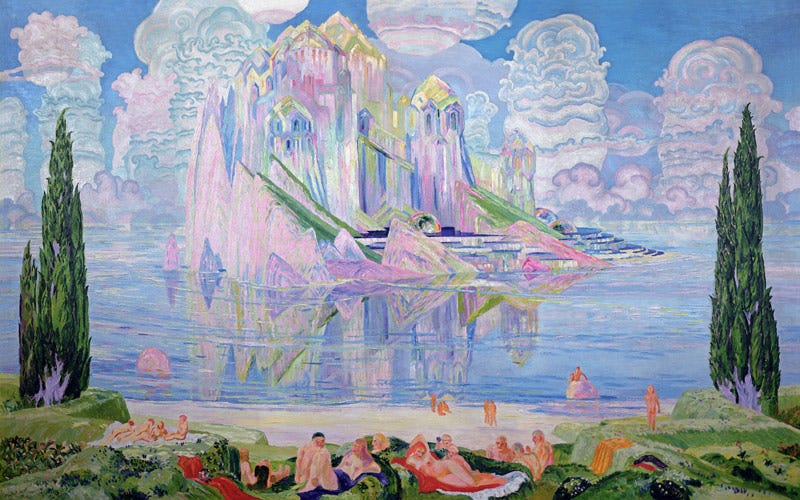
Wenzel Hablik: The Wonder of the Sea
Types of Knowledge, Types of Writing
I have written about the idea that the novel—and literature more broadly—is a kind of collective, intellectual (or spiritual) adventure. I have made this claim both in my critique of the MFA-novel and in a loose rhapsody about the microcosm. But I know you guys also want concrete details, but before giving a comprehensive account of the realm of literature, I must distinguish it properly.
What I am calling the “two literary realms” are really corollaries of the two types of knowledge that human beings can possess: the knowledge of control and essential knowledge. Not everyone believes in the second kind, which is part of what’s wrong with the world today, but I want to give you guys a full picture so you can decide for yourselves. Some, like sceptics and pragmatists, really only believe in the knowledge of control. Others believe in essential knowledge, which is “theoretical” in the Aristotelian sense—i.e., good for its own sake—whereas knowledge of control is merely practical.1
These deeper epistemological issues need not concern us here, but it is always good to know where this stuff comes from. What I’ll do here is show you all how both of these types of knowledge correspond to a certain “realm” that we can explore as writers, in a manner of speaking. I am interested mainly in the second level, where philosophy and literature reside, and future articles will focus on this area in particular.
The World of Entertainment
The first realm the world of entertainment. In some sense, this is not really a place you can explore in any substantive way because what’s at stake here is more a matter of control. Before making this point, I’ll say a bit about the knowledge of control in general, which encompasses much more than just art. Contemporary science, for example, is largely about establishing better control over nature.
If you bracket all questions about realism and the correspondence of models to reality when it comes to science, you find that scientific knowledge, as such, is primarily the knowledge of control: it allows us to bend nature to our will. The value of this knowledge is pragmatic; we use it to affect reality. Physics helps us build everything from houses to fiber optic cables; chemistry gives us gasoline and medication; biology brings about medicine. You get the idea. While there are people who pursue these activities for their own sake, most of us care about science because it works and it makes our lives better. From this perspective, it doesn’t even really matter whether the theories are true or not. What matters is that they work and allow us to shape the world as we see fit.
When it comes to literary arts, this control manifests itself in mastering techniques of “stimulating” the reader. This is not bad and books are meant to be fun. But exploring the realm of entertainment means learning the means by which to manipulate the reader into finishing your book: how to make them care about your characters, how to build suspense, how pull at their heart, how to turn them on, how to fulfill their need for resolution.
Again, all these are good things, but there is a worrying tendency these days to focus exclusively on dominating attention, which is why novels have become leaner and why many female readers are obsessed with ridiculous smut. This is really just the result of writers becoming more and more sophisticated and having better knowledge of control. They now know what works and what does not work. There are direct response principles for constructing an attractive headline. There are frameworks for how to tell a compelling narrative or create an interesting character. We know more about storytelling than any other culture in history by a long shot—in part because we have television, which works by maximizing entertainment value, and short-form slop, which works by maximizing dopamine.2
As I said earlier, one does not really explore this realm in a substantive sense. Everything is about entertaining (or in some cases, just controlling) the reader. We can learn about different tools and systems, we can master our craft, but everything here is pragmatic in a sense. What matters is to make the reader finish the book and to ensure that their experience was a pleasant one. This will differ based on genre, but that’s the basic idea. Discovery here is not really a matter of exploring the self or the universe but of inventing new methods of entertaining or titillating readers—and in that sense, monster erotica might be seen as a kind of new invention or technology.
There is an ostensible exception here, which the knowledge of things like the seven basic plots and the hero’s journey. These are actually part of both the world of entertainment and the essential world. Although it’s true that a well-structured tragedy or the telling of the hero’s journey is more entertaining, it also provides us with insights into deeper things. From the perspective of control, these are inventions that help writers tell more unified and interesting stories, but they also open us up to the good stuff: the realm of literature.
The Universe’s Essential Structure
Once we leave the world of entertainment, we arrive at the border of the knowable universe: the human being. The key claim here is that, in addition to mere sensual stimulation and a knowledge about how to control certain natural processes, a deeper knowledge of the cosmos is possible. Traditionally, this was the proper domain of philosophy.
There are many similar terms here: essence, archetype, form, idea, conception, essentia.3 Take your pick. Personally, I like the word “essence,” which is problematic in some ways because many people (including Aristotle in some passages) tend to run it closely with the idea of a concept, thus making it into a fixed, eternal thing that we come to know. That’s not my view. I’m using ‘essence’ as the early phenomenologists used it; I like the term and I’m sticking with it. But if you prefer Jung or Plato, many of the insights here will be the same.
The important thing is that the universe is assumed to have a deep invariant structure of some kind (Sophia) and that we, as homo sapiens—beings of wisdom—have the capacity to interface with it. There is also a link with philosophical knowledge. Philo-sophia means “the love of wisdom,” and Aristotle himself (in a passage that I can’t believe is not cited all the time) tells us that the lover of myth is also a lover of wisdom. The idea here seems to be that both fiction and philosophy give us knowledge of this deep structure—but I will save the details of what distinguishes the two for another time.
As I understand it, this is the primary domain of literature, and over the coming months I will go into more detail concerning the various problems and issues that this kind of view brings about. I have already written about the distinction between literary values and sensual ones here, but there are two additional points I wish to stress here. Exploration of this realm (1) has an emotional component and (2) is “objective.”
The first point is that essential knowledge concerns certain affective phenomena as well; it isn’t just about conceptual thinking. We feel that a poem is beautiful or that a story is profound, for example. Skeptics will often use this as a reason to lump essential knowledge in with entertainment, and there is a tradition of people—mainly positivists—who do just that.4 I won’t mount a substantive defence here, but there are reasons to think that this kind of skepticism is unwarranted.
The world of entertainment is comprised of one subset of feelings; the universe of literature is composed of values that we feel. The thesis here is that even though our contact with both these realms is mediated by feeling, there is nevertheless a distinction between the kinds of entities that are felt—and literature pertains to mental values.
The distinction is no ad hoc. For one thing, mental values like beauty and profundity are often thought to be higher and weaker than sensual ones; for another, they are far more difficult to reproduce. It’s pretty easy to put together a formula for a thriller or a romance novel, but it’s quite difficult to do that for beauty. It seems that the traditionally higher things are less and less subject to the will, more difficult to operationalize, and more resistant to time.5
It’s also possible to discover new literary (mental) values. Philosopher of the Oil Sands shows this in his wonderful article on the Alberta oil sands, which seem to possess their own kind of sublimity. Poets, historically, are kind of “pioneers of feeling” who dive into inner chaos and give the emotional life its shape. Such people do not merely stimulate our curiosity but actively shape what and how we feel. This is a complicated topic, however, and in addition to values, there are also atmospheres and even more mysterious things to be discovered here.
The second and surely more controversial point is that this structure is objective and that the kinds of truths we discover here are necessary ones. I wrote about this in my little rhapsody about the microcosm:
To live is to suffer, and there are moments that are not just sad but tragic. Those moments, too, are relative to me, and yet tragedies happen every day. One can focus on what differentiates them—on the specific person or set of circumstances—but all tragedies share a common core, and to grasp the essence of the tragic is to intuit that invisible pattern which flows through the innumerable variations of human existence. In those moments of insight, we are brought beyond the confines of our subjectivity and grasp some inkling of the deeper laws that bind all lives together. To know what’s tragic about Oedipus, Hamlet or Anna Karenina is not just to know something about Oedipus, Hamlet or Anna Karenina: it’s to feel the universal bond that unites them in sorrow. And what we discover links us to people in the real world as well.
This presupposes some fairly sophisticated epistemological ideas, but these need not concern us here. The key point is that we all live in one universe. Even though we each have our own individual perspective, we are all fragments of the same whole, and the same essential laws regulate every possible perspective.6 The realm of literature therefore consists of those laws that are discoverable through literary exploration. This doesn’t mean that every person can grasp these laws, or that different cultures don’t facilitate knowledge of distinct parts of it—but at base, real literature is not merely constructive but evocative: it “calls forth” from the depths of the heart, whose foundations rest on the eternal. This link with universality is why works of literature can move us just as much today just as they did a thousand years ago; it’s why a book from 19th-century Japan can touch a woman in San Francisco today. These things are beyond the boundaries and norms of the community, whose expression in art is relegated to what is ‘provincial.’
Literature is subjective in that it is always experienced by a subject, but it doesn’t follow from this that everything the reader learns is relative only to himself and nobody else. I take it that there can be objective knowledge of things like tragedy and absurdity, just as there can be objective knowledge about mathematics (and I know even this is controversial these days).7
The Limits of Literature
There are many details to be teased out here, but the main point is a simple one. In addition to merely “telling a story” or “expressing oneself” (which is fine), literature provides us with a lens through which to see ourselves more clearly, and the history of literature can be conceptualized as a series of expeditions into our shared humanity and a gradual clarification of that which is originally obsfuscated or “forgotten” (as in Plato). An important book casts new light on something, and the sense of unity gleaned from these insights is both deeper and more wholesome than a merely “seeing yourself” reflected in a character because he or she possesses similar accidental traits (gender, race, sexual orientation, etc…).
As literary artists, it seems to me that we should focus on the second realm, on the universe—universus, ‘combined into one, whole.’ At the same time, I do think it’s important to make our work entertaining.8 Adventure is not just about discovering new lands and new parts of existence; it’s also about having fun. And a little knowledge about the world of entertainment can make one’s voyage into the profound all the more pleasant. It seems like a distinction between where the writer takes you and how comfortable he makes the journey.
It seems to me that many writers today have forgotten that they can go beyond their bedroom. Most don’t even know that there is something out there to discover and shun their true vocation as explorers of existence and expanders of the microcosm. I look forward to the day when these ideas become popular once again and will do my part to ensure that this comes to pass.
If you have specific questions about these topics, please comment below. It’s very helpful for me to know what people are curious about and what to focus my efforts on in the future. Thanks.
-Krug
Religious types sometimes further distinguish essential knowledge of the created from knowledge of the uncreated, thus separating theology from philosophy proper, and some figures like Nietzsche seem to deny essential knowledge while countenancing a kind of redemption through a full acceptance that control (power) is all there is. But I will not deal with this here.
It’s an interesting question as to whether these are the same thing. My gut says there is a distinction to be made here, but I have no views as of yet.
As Rajeev Ram and Otto the Renunciant have informed me, there are Eastern notions that are relevant here as well, especially with respect to how I am using these terms. But I am not an expert in this area. The point is: my view is consistent with a dynamic process of complex interconnections and context-dependent relations. I do not believe in static, independent forms! This is a nerdy point, but it is an important one.
The logical positivist Edgar Zilsel, for example, basically identifies profundity with sentimentality, which would make it just another way to manipulate the reader.
There are many more reasons to think that these things differ categorically as well, but I won’t go into it here.
I will do a future essay on perspectivism. This is a topic many people are confused about, and there is a tendency to confuse the epistemological and ontological senses of being ‘subjective.’
As with ‘subjective,’ the term ‘objective’ is also used equivocally. I only mean that these things are not influenced by personal feelings and taste.
Once you begin thinking about this, a whole series of interesting questions open up that I will only hint at here:
What is the relation between exploration and a tradition or a lineage?
How do we come to possess essential knowledge?
What is an essence, anyway?
In what capacity is the artist genuinely creative?
What, if anything, differentiates literature from philosophy?
How is it possible to acquire objective knowledge through the subjective act of reading?
As you can see, all this is quite wonderful.
Much of contemporary fiction seems committed to the idea that there is nothing beyond the self, that the world doesn't exist.
I’m with you on this, but I would offer that you’re using pragmatic and pragmatism in a way that glosses over the more sophisticated work we find in Peirce and others who aren’t merely the limited-scope James version.