
Esoteric Hallmark Card Wisdom
Some thoughts on old magic treatises, platitudes and mysterious nature of profundity


Clichés and Christmas Cards
I’m sure you were all bombarded with clichés of all kinds during the holidays, with meaningless platitudes about the Christmas spirit, the power of love and other such nonsense. When I was younger, I was deeply interested in clichés—that is, I was interested in understanding why I hated them so much. I read and reread Martin Amis’ essay collection, The War Against Cliché, and I developed an ethos that was focused on the creation of new things and on seeing the world in new ways. I had an almost visceral repugnance to feel-good slogans and words of common wisdom back then.
Now, nearly a decade later I find myself in a horrible position: many of these stupid clichés are true—and worse yet: they’re profound. “The journey is the destination,” “love is the answer,” and so on… I actually find all these things very interesting, but when I bring them up I kind of look like an idiot.1
I feel like a conspiracy theorist with wild views he knows to be true but can’t prove, or like the oracle Cassandra, who was fated to know the future and never be believed. Krug: the philosopher who likes clichés and platitudes… a tragedy.
This has recently led me to think more deeply about the essence of clichés, platitudes and proverbs.2 What I’ll do here is distinguish between two modes of reading a cliché, proverb, aphorism, maxim, or what have you. Then I’ll show that what we commonly refer to as platitudes are the result of erroneously conflating profundity with obscurity. In the end, I hope you’ll see that at least some of what is easily dismissed might be more interesting than previously thought.

On Reading Magic Texts
I will now introduce you all to a little-known work of mystical philosophy called Il Mondo Magico degli Heroi—or The Magical World of the Hero (no English translation available—yet!). This little volume was one of the main sources of Julius Evola’s work The Hermetic Tradition, which is a cool book whether you like Evola’s views or not. Apparently, he uncovered it in some old library and produced a modernized Italian translation. Say what you want about Evola, but he was very industrious for a wannabe wizard.
According to Evola, this book is the premier distillation of Western esotericism.3 I don’t know enough about the subject to judge whether this is true or false, but will say that I found it very interesting. I think the ideas inside might be especially attractive to people today because the overarching metaphor is that of Heracles, whose heroic trials are supposed to mirror inner transfigurations of the soul, yielding otherworldly power and enduring bliss. The heroic task of man is to build a “world” (which is the philosopher’s stone) and become immortal. I haven’t seen this specific view anywhere else, and I think I its a pretty healthy outlook to be honest—far healthier than most of what’s popular currently.
I won’t expound della Riviera’s system here, but one insightful (and entertaining) passage of this book is highly relevant to what I want to discuss. This has to do with our capacity to understand the mysteries. The old masters wrote in an obscure language of coded symbols so that the common folk wouldn’t confuse the true meaning of their work and misuse it—very Straussian. Only those who are led by “wisdom” could find the truth. But this kind of trickery isn’t necessary, according to della Riviera. Like me, he believes in clarity and order.
I have taken the time to translate the opening where he says this.4
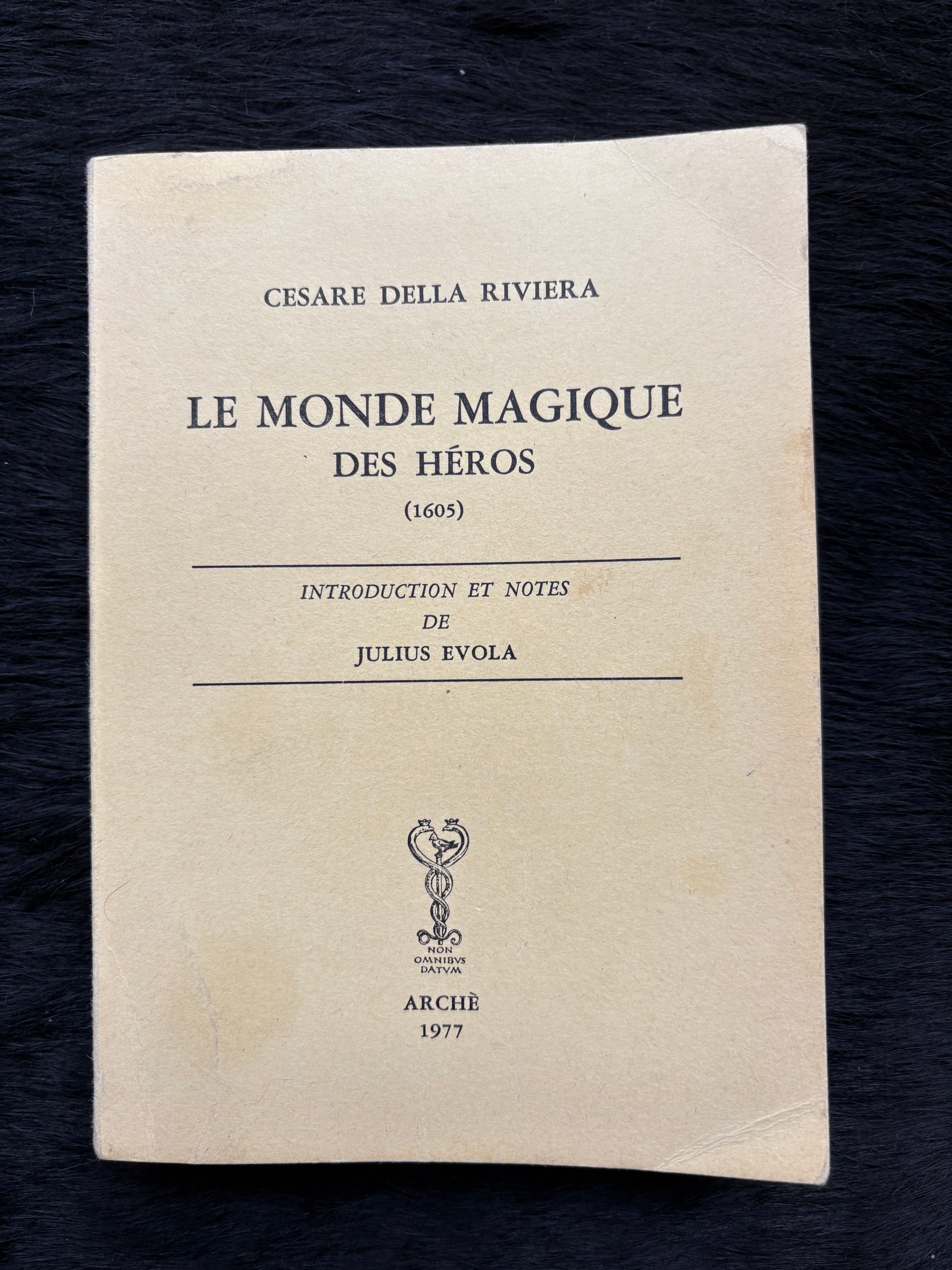
My copy of a French edition.
Cesare della Riviera’s Author’s Note
(This is not necessary to read for the article, but it is cool.)
I have set myself three main goals in composing these essays on magic and nature, namely, to know clarity, order, and truth: qualities and conditions which render any composition honorable, welcome, and worthy of living forever, but which at the same time are not easily found and joined with unity and completeness in the human sciences. And even after much discomfort and difficult work, when these sciences show themselves adorned with such precious ornaments, Natural Magic, its chief and Queen, openly throws them off like an enemy who disdains them. As far as I know, among the innumerable ancient and modern writers who in any way dealt with the nature of this art or treated some specific aspect of it, not one of them aspired to or even wanted that these conditions should shine and stand out. Only the natural Magi rigorously banished these qualities, and deliberately made them so distant and hidden within their volumes.
As to clarity, who does not see all the obscurities shadowed within those books and with what artifice the mysteries contained therein are veiled and covered? Moreover, to make this obfuscation even easier, these Magi are accustomed to treating their dogmas not only with their own magical terms but also with those of some other sciences, faculties or arts: then, by indiscriminately using every allegorical style and also employing enigma, metaphor, or any other figure whatsoever, they attempt to offend and to chase away the aforesaid clarity. Not content with all this, they add to such an obscure mess the perversion and confusion of order, since they never treat and arrange their magical doctrines in an analytic manner, choosing instead to move about without any method, for they have the custom of sometimes putting the end before the beginning, or putting the middle at the beginning, or of being silent and neglecting beginning and end altogether. They also have the habit of frequently providing alongside the solid and real doctrine a second one, a distorted mirror in which everything is false, vain and useless, so that the fragmentary company of vulgar minds abandons the true meaning and clings frivolously to an apparent shadow. Such techniques are employed by the heroic Magus to disguise and hide the truth from the unworthy: the real truth is found within these obscure and confused writings, though she shows herself only to those with the sure escort of wisdom, to those who have a keen eye for entrances hidden along intersecting paths and obscure places. (my italics)
Now, my own brief thoughts bring an order and a clarity to the judgment of those who have uselessly spent a great part of their years in the highest and almost inaccessible speculations of occult philosophy, which is none other than natural Magic: but alongside those those two a third element, truth (however, by means of the divine grace), will also be knowable and clear, since I have stripped her of her dark and caliginous cloak, which was imposed on her by the ancient Magi, and since, now standing quite naked and resplendent, I represent her in the eyes of others so that she might be sincerely shown.
Understanding of the Spirit
Despite della Riviera’s insistence on clarity, his book is actually quite a mess to read and not clear at all. Later in the first chapter, he says that it doesn’t really matter how clear he is because the truth is only revealed through grace anyway:
Since, as Blessed Basil affirms in The Book of the Holy Spirit, obscurity is a certain kind of silence, we have therefore again resolved in this, against universal usage, to absolutely banish all riddles, metaphors, parables, and other figures and obscurities, and in their place, write orderly and with a full and clear method: having in us the assurance that those elected by God to receive such a great gift will be presented with a very vast light here. Thus God Himself, who with great wonders hardened the heart of Pharaoh, will again cause the reprobate and the perverse to go blind and deaf before our words. And of this no one doubts, being very true the sentence of Geber, that wise King of Arabia, when he says that this is a gift of God who gives and takes it to whomever He pleases. From which is evident the argument that among an almost infinite number of those who curiously seek it, there is hardly one who is made worthy of it.
It seems related to the ideas of Nicolas Cusanus, who is a kind of epistemological proto-Nietzsche in the Renaissance;5 according to him, all conceptual truths are false and real truth is only accessible through some kind of non-conceptual visio intellectualis. I know guys like Augustine have similar ideas as well.
My view, funnily enough, is that many common platitudes are like this. They actually express some profound truth, but we often can’t see it. They’re clear as day, yet we think in darkness. Moreover, it doesn’t seem we can be led, step-by-step, in some deductive way to their apprehension. In my own case, the real power of these proverbs comes in a flash—unified and expressing a thousand different things at once. I’ve read some texts many times, and then all of a sudden, it just clicks into place somehow. I’ve even spent many nights puzzling over the famous Mutus Liber, a book with no words at all whose images are supposed to contain all the secrets of alchemy. And I feel that I gained something from these sessions, too.
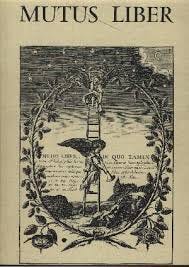
That’s not to say we can’t do anything to prepare for these revelations: this thesis just means they can’t be willed or arrived at by some fixed sequence of logical derivations. I know that studying Aristotle’s concept of “movement” brought forth a flash of lightning that forever altered how I thought about life’s journey and the meaning of action. Would that happen for other people? Maybe, maybe not. But I think one purpose of intellectual study—a purpose which has been largely neglected today—is to facilitate these intuitive breakthroughs.
At times, I have felt that each piece of conceptual knowledge is a lens into life’s mysterious depths, and the more lenses there are, the clearer the picture. But at the same time, one can look for years and see nothing but the smouldering glow of these empty concepts. Then, one day, without warning, the true fullness and majesty of the idea reveals itself like a wink of magnesium. Some people experience these insights through the contemplation of a single proverb; others know a book's s worth of theory and remain in darkness. The epiphanies come of their own volition, and the best we can do is prepare the space for their arrival.
But I think this is definitely true. Something like “the journey is the destination” conjures a hundred different things for me now: Aristotle’s notion of activity, timelessness, different senses of the word satisfaction, a certain kind of love, poems memorized, hockey games lost, et cetera… Presently, I can’t perceive that shimmer of higher meaning. I have felt it before, but I can’t call it up from the depths the way I can summon my conceptual knowledge. Even the memory of it is a dead thing. Ultimately, irrespective of our beliefs about God or fate, we must resign ourselves to the fact that the best things in life are beyond our control. All we can do is make time for them, which is the proper purpose of contemplation.
Profundity is not a heady thing: it belongs to the heart and is felt, not thought. The issue today is that most of us never feel very much of anything. How many people merely believe in things? How many of us go through the motions, performing mechanically what was once spontaneous and alive?
Profundity and Platitudes
Since I believe in this mystical kind of profundity, I feel that I ought to distinguish it from what is merely pseudomystic and obscure. What’s interesting about the kind of profundity that I just wrote about is that it can’t be reduced to any one interpretation: there is no correct meaning that can be clearly articulated propositionally. To the extent that these things are profound at all, they exist beyond language, which at best can help to facilitate their apprehension through a kind of pointing. We cannot denote these things in any substantive way, but I think we can be better or worse at pointing.6
If this is correct, it fits very well with della Riviera’s musings about magic. There can be no “correct” formulation of these things in language, no perfect mirroring of what lies hidden in the deep. For that reason, there’s no need to write in symbols and cyphers. Only through luck or grace can we come to know the deeper meaning of things.
This naturally leads to what distinguishes a genuine proverb or aphorism from a mere platitude.7 Put simply: a platitutide is created when one especially stupid interpretation of a proverb is falsely identified as being profound itself, and then repeated ad nauseam.
In this way, something genuinely deep (and clichéd) like “it’s all about love”, which can refer to the loving act’s supreme value as something that transcends the self’s boundaries, or to a movement which is concerned with no fixed objective but which is good in and of itself, or to the ground of being’s pull as the final cause of the cosmos—this is reduced to something so facile as “be sympathetic.” What’s worse, people who champion this kind of thing begin to think that sympathy itself—a rather passive and unimportant phenomenon—is secretly the highest good because… well… just because. Somehow the content of the proposition itself is imbued with a false sense of profundity, and thus, a rather unintersting idea is elevated to the status of a moral principle.
Worst of all, we sceptics are told that “we just don’t get it” even though there is nothing to get. This kind of thing inevitably leads to a reaction which goes along the lines of, “it’s not that deep, bro.” And in the end we have people, like my younger self, who scorn all pretences to profundity as being boring and obscure, which is a mistake on both accounts.
As it turns out, other conceptions of love, like the ones I mentioned earlier, are actually very interesting. There are many ways of spelling out these clichés that makes them worth thinking about, but it’s a mistake to identify the actual profundity with any particular interpretation: it lies beyond such things altogether. The very vagueness of these sayings allows them to be interpreted in many different ways, with some being more interesting than others, and this reluctance to fix a definition is part of what facilitates our intuitive penetration into the ineffable.
Therefore, we can draw a sharp distinction between meaningful aphorisms/epigrams/proverbs and platitudes. The former are vague but permit the possibility of profound, non-linguistic insights, whereas the latter are fixed and simple, allowing for no deeper thought. The one gives us space to contemplate; the other reinforces a simplistic idea and insists on its importance. Of course, this is depends not on the actual sentence itself but on us, on how we read and think and feel.
This leads to another distinction: the difference between profundity and obscurity. That which is “pro-found” is “before the bottom,” where it’s deep and dark. Profundity has an essential inscrutability about it: we can’t ever perceive it clearly, except in those rare flashes of inspiration. For that reason it’s also mysterious and beyond our understanding. What is “obscure” is also dark, but this darkness is due to being covered in some way. The obscure, too, is inscrutable—but this isn’t because it’s profound. A very common error today is for people to conflate these two things.
I, for one, believe there are mysteries out there and that the human being, as a homo sapien, is capable of interfacing with the world in supra-linguistic ways. This is very different from being mystified by something incomprehensible or from treating these words as magic “symbols” of some kind. Many charlatans have exploited this confusion over the centuries, some without even realizing they were charlatans.
What’s annoying about platitudes is that a relatively banal and uninteresting conceptual idea is invested with preternatural mystery. The people who go around repeating these slogans like robots not only have nothing of interest to say, they also erroneously believe that their words are profound because they don’t understand them very well. They seem to get high off their own lack of understanding. When someone tells us that “everything happens for a reason,” they’re not saying it because they’ve intuitively grasped some deep mystery about the forces of fate and destiny: they’re just repeating a simple idea because it makes them feel good. Their ignorance is misperceived as profundity, and the dark of cloudy waters is misinterpreted as depth. Thus, a colourless thought is coated in emotional lacquer and pawned off as a pearl of genuine wisdom.
I sometimes wonder if the ancient habit of writing unclearly was done solely because of how annoying this is.
How to Know? What to Do?
The big issue here is that, so far as I know, there isn’t a way of distinguishing between people who just repeat nonsense and those who are attempting to use their words as a means of pointing towards something beyond language entirely. This means that sometimes platitudes actually are profound: the problem isn’t with the words but with the people who say and interpret them.
My life has recently become very annoying in this respect. It seems that with every passing year, some crusty old cliché is stripped of its greenish patina and begins sparkling with insights. I now find myself telling people about how love is the answer, how the journey is the destination, and admonishing them to follow their heart. My younger self would kill me if he saw this… Sometimes I try to phrase these things in other ways, which inevitably brings about the accusation that “that's just another way of saying [platitude].” But I find myself often saying exactly what the morons say.
The point I want to end on is a kind of warning: although there are many stupid platitudes out there, some of which appear to have no deeper meaning (though I’m hesitant to even say that!), I think our hatred of these things can, ironically, obscure what’s actually profound.
We are now accustomed to leaden concepts being peddled as golden nuggets of wisdom. I know I have made the mistake of ignoring some truly interesting and profound aspects of life because they were insufficiently distinguished from commonplace nonsense.8 Personally, I think we should all try to read more alchemically: transforming vulgar nonsense into the noble insight.
For these reasons, you might catch me writing some ostensibly stupid stuff on here from time to time. I think being anxious about appearing a certain way is a waste of one’s energies, so I’m not going to go out of my way to avoid this. After all, you can’t please everyone, and everything happens for a reason. You win some, you lose some—and all you can really do is your best. It is what it is, and everything will work out in the end. That’s life. …
So, whenever you come across any Hallmark Card bullshit, take a minute to really think about it. Despite the insistence of small-minded men, the world is full of mystery, though it’s often hidden and revealed only when you don’t look too close. Robert Frost was very interested in this, and I’ll end with his poem, For Once, Then, Something, which expresses this theme well:
Others taunt me with having knelt at well-curbs
Always wrong to the light, so never seeing
Deeper down in the well than where the water
Gives me back in a shining surface picture
Me myself in the summer heaven godlike
Looking out of a wreath of fern and cloud puffs.
Once, when trying with chin against a well-curb,
I discerned, as I thought, beyond the picture,
Through the picture, a something white, uncertain,
Something more of the depths—and then I lost it.
Water came to rebuke the too clear water.
One drop fell from a fern, and lo, a ripple
Shook whatever it was lay there at bottom,
Blurred it, blotted it out. What was that whiteness?
Truth? A pebble of quartz? For once, then, something.
This is a thread with Rajeev Ram and Gene Botkin that helped inspire this article. As did personal conversations with Rajeev, who accused me of being a promulgator of “Hallmark Card bullshit.” All in good fun, of course.
I won’t deal with clichés here because they have a historical dimension, and that would just take too long; even something like an aphorism is tricky because it’s related to definitions (etymologically, that’s just what the word means).
This is not crazy, as the book was written right at the end of the Renaissance, where lots of progress was made in this area. And della Riviera is very comprehensive.
If you read Italian, this book can be found pretty easily—but fuck was it hard to procure this edition. I felt like Indiana Jones tracking this thing down.
This has not been explored thoroughly. Exciting area.
That doesn’t mean, however, that some expressions might be more or less obscure. della Riviera tells us to write clearly, but he’s emphatic that the real understanding can’t be transmitted through concepts alone.
There is a relation between platitudes and clichés, but this get’s into the way meaning changes over time, which is something I do not want to address here.
The best example of this, in my case, is the command to be more empathetic. There are actually (at least) two forms of empathy: one where the person passively mirrors the feelings (which is linked to psychic contagions) and another where we intentionally feel with a person and yet remain ourselves. The latter is extremely powerful, but recognizing the relative uselessness of the passive form of empathy can obfuscate this fact. The real profundity is only perceived in the act of being empathetic, and if we fail to make this distinction, our lives are impoverished.