
Beyond Traditional Morality
Distinguishing between mores and moral virtues

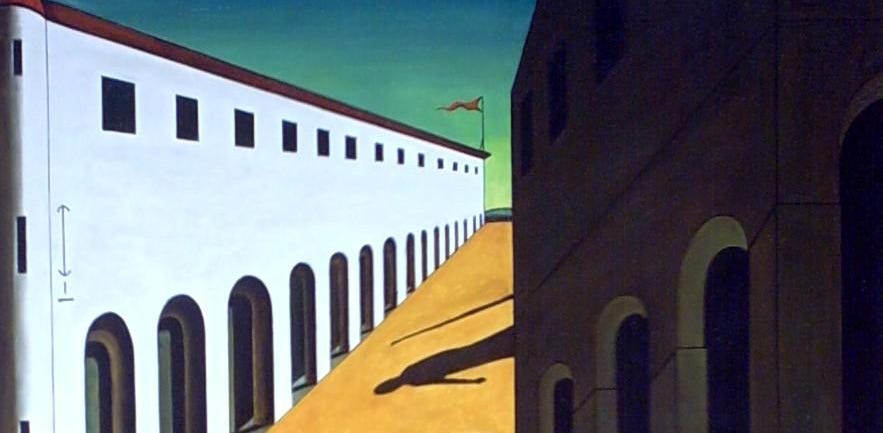
The Mystery and Melancholy of a Street by Giorgio de Chirico
Which Way Philosophical Man?
I have a few articles in the works about moral philosophy, but in an effort to keep those pieces trim (and comprehensible), I have decided to lay out some of my foundational concepts. I have already talked about valueception and the idea that ethics is grounded in the emotional life; here I will make the claim that there are two distinct kinds of moralities that correspond to two classes of moral values.1
Call me old-fashioned, but I believe in moral goodness. In my youth I was warm hearted nihilist. Thankfully, I am blessed with very low neuroticism and very high extraversion, and my views were just the natural consequence of my philosophical positions, not a result of ressentiment or any malignant emotional problems. As a result I avoided basically all the normal forms of suffering that nihilism tends to produce. I just did whatever felt good, and eventually this process of total acceptance led me towards more traditional positions. I didn’t have a come-to-Jesus moment; I just eventually saw that my views were wrong—or if not wrong, then too limited.
I now find myself in agreement with many of the most trite clichés, and some of my views are rather traditional. However, I feel absolutely nothing in common with most ‘trads.’ I have no desire to return to the past or to emulate old forms. I am a pioneer at heart and I want to move forward. At the same time, I feel like an anachronism among the more forward-facing vitalists and technocratic pragmatists. I know some of you are stuck in a similar position, and my hope is that what I write here might show a middle path between sterile traditionalism and unfulfilling amoralism/nihilism—or perhaps a way to take both paths.
Two Types of Moral Values
Moral values are those values that pertain to right conduct between people. Some have held that these are of the utmost spiritual importance; others that they are useful fictions that bind society together. Most debates online take one side or the other. Religious folks hammer away about the importance of moral goodness and skeptics reduce moral phenomena to biological drives, pointing out how many moral norms enmiserate those who follow them.
The big move here—which is something I have not seen put in quite this way before—is to distinguish between two kinds of morality. My claim is that there are actually two non-overlapping senses of the term based on two distinct classes of moral values.
There is much to think about here, but everyone should be able to recognize the essential differences between these two kinds of morality: mores (customs) and moral virtues. The first is a study of the moral structure of community; the second is about the inner laws of the individual. These two correspond to a distinction between different classes of values as well: ‘communal values’ and ‘genuine moral values.’ I will now show how they differ.2
Mores and Communal Values
Mores and communal values are what structure social life. They present themselves as different kinds of rules, as thou shalts. Purity/pollution laws, for example, indicate who is an outsider and who is a genuine member of the community.3 Rules like this also dictate what kinds of things are good/bad. But communal values themselves have no real ethical import: they’re not beyond good and evil but below it. They just structure the conventions of the community. Contravening boundaries is associated with terror, anxiety and disgust; following the rules makes brings about security, pride and a sense of cleanliness. Some autistic people seem to be blind to mores to varying degrees.
Communal values also have the unique quality of requiring a symbolic system to be perceived, which is makes them rather unique. These values are characterized by the fact that they are only given through ‘value-symbols’ that are constructed by human communities. Jews think pigs are polluted; indians see cows as sacred; feminists see masculine men as polluted; et cetera. The members of the community feel these values, but they must be embedded in a symbolic structure to be perceived, which means that an interpretative framework is always presupposed.
The analogy here is dirt, which is “matter out of place.” It makes no sense to talk of dirt in itself.; it always presupposes a form of order that is contravened. Eating meat among vegans will mark you as an outsider, but go next door to a BBQ restaurant and you’re part of the family. Objects and acts become invested with meaning, but this is always relative to the community as a whole. At base, mores are the result of life developing in unique ways, which makes all mores vital values despite the fact that they pertain to the collective and not to a biological organism.
We can even treat the community as an autonomous entity in a way. This is related to the concept of egregores or ‘group souls,’ but we don’t need to countenance any occult entities. This is a view that we find in sociology, and it is related to Durkheim’s idea that the dangerous powers attributed to the gods are actually the powers of the social structure itself, the purpose of which is to defend itself, as a structure, from the destructive behaviour of its members. The moral rules of the community, therefore, are what structures individual human beings into a larger communal whole. Communal values and mores can become internalized, but they are always bound up in a symbolic system and have their origin in social reality.
Moral Virtues and Genuine Moral Values
Genuine moral values differ from mores in a number of ways, which is why it makes sense to put them in a seperate category. First, they are not given through culturally conditioned symbols but are more primitive in a way. There is no need for a symbol of heroic action: we just see when something is heroic.4 Our ability to perceive these values is still mediated by culture, but they are not disclosed according to a fixed symbolic system the way communal values are. Their bearers are undetermined, and explicit symbolization tends to eliminate them.5
Furthermore, genuine moral values are relative to individuals, not groups. They pertain to how we as individual persons interact with other people; they are relative to us. Unlike a pollution rule, which seems to delimit the boundaries of a community, nobody really knows what genuine moral values do. Reductionists hold that they are basically just another expression of communal bonds, but more speculative and religious thinkers hold that they have a divine significance of some kind. Importantly, if there are such things as virtues and genuinely ethical morality, then they can only come from genuine moral values, which always presuppose a person and often seem to conflict with one’s vital interests, making them mental or spiritual values. This fact is why many vitalists see them as expressions of declining life and why religious people often attribute them to God.
Genuine moral values are also comparably weaker than communal ones, meaning they provoke less intense emotional reactions.6 Failing to observe a moral imperative as generated by a genuine moral value often leads to shame, but the conscience is rather quiet. Interestingly, often moral success brings about feelings of modesty, not happiness. There are many cases of heroes who seem to take no pleasure in their achievement and who even dislike talking about it. Psychopaths are blind to genuine moral values. If there are valid conceptions of good and evil, then they only pertain to these values.
Finally, they have an aesthetic association, and it is not uncommon to feel that an act of moral goodness is beautiful in some mysterious way. This aspect is not emphasized very much because, at least in my experience, genuine moral values are quite rare—or at least a clear impression of them is.7 Most moral phenomena are a matter of community, but the highest and most important pertain to genuine moral values and the moral virtues of the person.
A Few Differences
I hope this short section is enough to illustrate the difference between these two classes of values and the two domains of enquiry. Much, much more could be said about both of these, but I think this is sufficient to show that we have good reasons to distinguish them. Again, this is not an intellectual ‘solution’ to some abstract quandary; we are simply discriminating based on the different phenomenological characteristics that these values possess. To summarize:
Symbolization
Mores are always encoded in a symbolic system
Genuine moral values are symbolically undertermined
Relativity
Mores are relative to a community (a moral system is public)
Genuine moral values are relative to an individual person (virtues are private)
Beauty
Mores are never described as ‘beautiful’ and if they provoke an emotion, it is usually that of terror
Genuine Moral Values have an aesthetic component and seem beautiful
Blindness
Autistic people are often blind to mores
Psychopaths are blind to genuine moral values
Type
Mores are in the sphere of vital values and ensure the healthy of the community
Genuine Moral Values are mental or spiritual values and pertain to the moral goodness of the person
Ethical import
Mores are ‘anethcal’ and merely refer to norms about what is good and bad relative to the community
Genuine Moral Values are ethical and refer to good and evil8
I don’t expect everyone to agree with me, but I would be curious to see where objectors see the problem. I bet if I continued to think about this I could come up with additional differences, but there is such an obvious division to be found here. We will now see how these two things are related to one another.
The Relationship Between Moral Virtues and Mores
Now that you’ve seen the difference between these two types of morality, you’ll start to notice how almost everyone conflates them. This is the primary error that I see in all discussions pertaining to traditional morality. Traditionalists emphasize genuine moral values and more amoralist/nihilist thinkers critique mores.9 The correct move, in my view, is to recognize that these are two separate fields of enquiry—not distinct sciences!—that most moral values that we talk about are doubled: there are mores based on symbolized communal values and virtues based on genuine moral values.
Consider the differences between pity as psychological identification and sympathy as intentional co-feeling, between chastity as a purity rule and individual sexual restraint, between the false modesty that comes from fear of being attacked and the genuine desire to preserve something pure, between the false humility of the man who uses weakness to rule and the genuine willingness to serve that the humble man possessess, et cetera. I’ve never seen this laid out before, but there are so many divisions like this that it just makes sense to treat them as two different fields of enquiry.10
The Example of Chastity.
Most moral rules about chastity are pollution rules that structure the community; having sex before marriage is seen in many communities as taboo. There is also, however, the moral value of chastity as it pertains to the individual, and in this case taboo has nothing to do with it. The value simply discloses itself to the individual as something of importance for him. A corollary of this is that there are also two kinds of shame: one where the individual is shamed by the community and one where he feels that he has wronged himself, his conscience.
I’ll give a personal anecdote to help illustrate this. About a decade ago I was studying in Prague and I had a cute little Czech girlfriend while I was there. This was me at my most nihilistic—intellectually, that is. I didn’t care about morality at all, but I was very interested in art, which presented itself to me as something intrinsically valuable. One weekend I went with a friend to Budapest. We stayed at the hostel and went to a late-night party at one of the baths. One of the girls from our hostel took a liking to me, and before I knew it we were making out in the pool. When we got back to the hostel, she invited me to her room, but in that moment I felt something very interesting: I had the distinct impression that sleeping with her would be… ugly.11 She was very beautiful, but the act would not have been beautiful. I didn’t care about judgment or even really about the well-being of my Czech fling (who never found out); rather, I just felt that it would be unaesthetic to do this. And I turned the poor girl down.12
The point is that this was a form of chastity in a way, but it had absolutely nothing to do with the mores of any particular community that I was part of. If anything, it was might have been taboo to refuse such an advance in that environment. I didn’t feel bad about my decision, I didn’t feel that I had missed out, and I definitely didn’t feel that I had submitted to any extrinsic thou shalt. I was just primitively aware of my own private you should, which arose from the perception of a genuine moral value, and following that little intimation led to greater happiness and solidity on my part. I was veritably high on life back then, and to say that this was some kind of bad conscience on my part or the result of a repressed upbringing just seems ridiculous. It was clearly the right thing to do—for me.
When you look at the structure of communities, what tends to happen is that a tiny elite is copied by the majority. My view, which I will only sketch for you all, is that most moral systems are the natural result of an individual exemplar’s moral character becoming a norm for the community. He is chaste because he feels the moral value of restraint, but the community is chaste because they want to maintain group cohesion, because sex is ‘bad.’ The original form of chastity is quasi-aesthetic in the way I described and just strikes you in the moment, but mores regarding sexuality involve symbols for pollution. I know some traditions make this explicit and distinguish between the esoteric and exoteric parts of their religion, and there are many interesting questions to consider here—but this is all I will for now.
The Future Looks… Interesting?
In the end we get a nice division between mores (symbolically encoded communal values) and moral virtues (powers to realize genuine moral values). The former are impressed upon us by the world in which we live; the latter reveal themselves to us in flickers of profundity. The one involves our domination by the community; the other the liberation of the self.
Only genuine moral values could conceivably have any spiritual or religious import, but almost all negative critiques of morality focus on mores.13 There’s a common mistake in these circles where a more is rejected and then its genuine axiological counterpart is thrown out as well. Many recognize the cultural variations of chastity and understand how it is a means for social control, but even if that’s true, it says nothing about the genuine moral value of chastity, which discloses itself to the individual as something beautiful and important for him. It’s probably the case that the highest and most profound experiences of sex require modesty and chastity to manifest themselves and that vulgar, unrestricted sexuality is just less erotic and valuable.14
Traditionalists tend to make the opposite mistake. They accept the importance of something like chastity, but often they obsess over aspects that have absolutely no genuine moral content. It’s just a matter of purity and pollution. That’s why some of the most fervent religious people are so excited to shout at the top of their lungs: they’re fundamentally interested in reinforcing the boundaries of the community and don’t really care about the genuine moral content of whatever it is they are championing. Many of them are fundamentally interested in bringing back traditional mores and customs, which seems like a waste of time to me.
I do not know where all this is leading, but as I will explain in a future article, that seems like a good thing. I am not a vitalist, but growth and natural development are ideas that are very close to my heart. Almost all the discussions I see around traditional morality are dead—i.e., boring. It’s about as frivolous to focus on a “RETVRN to Tradition” as it is to cite a few ideas from the Genealogy of Morals (which is almost 150 years old) and explain ‘slave morality.’ Going beyond traditional morality doesn’t mean incessantly attacking traditional forms and replacing them with equally outdated pagan ideals (or nothing); it means asking questions that were impossible under the old paradigm and working to develop new concepts.
I do not know where this will lead, but I definitely find these things interesting. And where there is interest, there is the possibility of real growth. I expect there to be more developments in the study of communal morality,15 but I think moral virtues and their corresponding values open up a distinct field of enquiry, one which involves an exploration of human consciousness and the profound mysteries of the moral life. This is what really interests me, and I am optimistic that it may lead us beyond what is presently known.16
My Novel
If this sort of thing interests you, and you may want to check out my novel, Pornoland. It is more of a work of poetry and has no detailed philosophical passages, but certain themes are related. I also think it is just a good book in general and initial reviews have confirmed this. If you enjoyed this article and would like to read some more of my stuff, this is the best place to start.
You can buy the book on Amazon or through my friends at Tortuga HERE.
If you’re curious, check out this post for more details about it.
I don’t actually know if any other philosophers have formulated things in quite this way. The idea came to me after I read a few books by Mary Douglas, whose work on symbolic systems opened many new possibilities for me. The view I lay out here is an attempt to integrate these anthropological insights with what I know about value ethics more generally.
Interestingly, my friend 𝐀𝐋𝐋𝐇𝐄𝐀𝐑𝐓 has informed me that what I say here is straight up Pauline. There are other historical analogues in things like Tantra, but nobody has taken such a precise, phenomenological approach so far as I know.
These differences are so pronounced that I sometimes wonder if they’re sufficient to warrant a division into two different fields of study. Traditionally, there is just the field of Moral Philosophy, but the study of communal morality seems analogous to the distinction between astrophysics and physics, or between immunology and biology.
The sacred and the profane go here as well. There are probably others, too. I think status symbols probably fit here. Sometimes I think there are symbols that are meant to induce emotional identification.
Obviously, there can be symbols for heroism, but these are not necessary.
This is why a story can be beautiful and moral but a piece of moral propaganda is worthless. For some reason, these things break under the weight of fixed meanings.
I have written about the inverse relation between power and height in this essay on literature and aesthetics. There is an analogous relation between sensual pleasure and aesthetic pleasure. Von Hildebrand talks about the ‘subjectively satisfying’ and the ‘objectively good,’ but this fails to capture the fact that communal values are ‘collectively satisfying.’
This could mean that I am just not a very moral person, but it seems to me that these things are actually very uncommon, and I believe there are people obsessed with ‘morality’ who have never had a true moral impulse, never felt the purity of a genuine moral value. They are incomprehensible to the vulgar, just like acts of nobility are.
Some philosophers simply define evil as choosing a communal (or egoistic) value over a genuine moral one. Even if you didn’t believe in God, the concept itself has a different meaning than the goodness and badness that is relative to a community, even if a community refers to acts of transgression as ‘evil.’ You still need the distinction.
In fact, basically all of Nietzsche’s critiques of morality are critiques of mores.
Even if you wanted to reduce genuine moral values and moral virtue to the vital sphere, you would have to treat them individually instead of conflating them with their communal counterparts.
I hadn’t readit at the time, but there is a similar idea in the Gorgias, and Socrates asks whether it is worth to commit injustice or suffer it. Polus claims that it is worth to suffer, but Socrates asks, “Well, it’s at least uglier to commit it?”
Nietzscheans could probably win back all traditional moral values by appealing to this aesthetic aspect, at least if they hold a “vitaesthetic” ethos and not merely a vital one.
Nietzsche is incredibly perceptive when he critiques mores, but he tends to often go too far and throw out the genuine moral value, too. Although it’s not a more, pity shares many of the same qualities. It is a kind of emotional identification where two or more people suffer together. Nietzsche rejects that, but he also rejects Christian love which is a feeling of the other person that doesn’t lead to emotional identification. He rejects social shame and redescribes the conscience in light of it. He understands modesty as an attempt to avoid punishment but fails to see it as a means of protecting what is perceived as valuable to the self.
Most people reject genuine moral values on ontological grounds, but you can ignore that and just pay attention to the world as it is disclosed.
Recently a few vitalists made the point that our age is not very sexual despite the fact that sex is everywhere. BAP makes this point, and Gildhelm has a good article on this. These people sometimes seem to identify all chastity, shame and modesty as a bad thing, but it may be that their communal forms are hostile to life but that their genuine moral exemplification is merely a natural development of becoming. I have not seen this view very much, but it is probably correct.
This is what Johnathan Haidt’s work is about, and Substack’s own Dmitry has his theory of biofoundationalism.
For those of you still skeptical that this is beyond traditional morality, consider this: what I have explained here is related to the Hashasheen—“the invincible order of Assassins,” as Nietzsche once termed them—whose leader, Hassan-i Sabbah is credited with the quote: nothing is true, everything is permitted. Nietzsche reads this in his own way, but it is probably more accurate to interpret it as saying, “All moral systems only symbolize communal values, but these have no genuine moral import, making them false. Every kind of act is permitted so long as it conforms to the order of genuine moral values and is an expression of moral virtue.” This is traditional in that one can find it in older traditions, but it seems completely beyond the crass traditionalism that is popular today. I will cover this in more detail in later articles.
I think you are absolutely correct. It's about beauty in the end. (I hesitate to say aesthetic, because the term seems to limit beauty to the sensible realm.) And how interesting it is that you describe traditionalists with the contrast between "purity and polution". Sounds very much like the Mosaic laws.
Super interesting article, enjoyed it very much. This idea for discovering ”self evident ethical action”, as being possible in the inner self, is somewhat similar to Kants Categorical Imperative. There are though some differences in the ”origin” of the moral feeling, and your moral feeling doesn’t make claims on what other people should do.
It’s a very interesting idea. I have had similar, although not as clearly articulated, thoughts on this matter. That which is right is that which seems natural and good to you yourself. The ”self” is capable of absolute moral determination it seems, at least from my vantage point. I don’t think every person has this ability, something you and allheart have spoken about in the scheler book club… either way, I enjoyed the read very much.